Before You Speak a Word: Why Your Arrival State Is the Most Underrated Variable in Any Negotiation
In the mythology of American business, the negotiator who wins is the one who prepares the best arguments, reads the room most acutely, and holds their position with the greatest resolve. These qualities matter. But they all depend on something that rarely appears in any negotiation playbook: the neurological state of the person walking through the door.
How you arrive—not what you say—may be the single most consequential variable in a high-stakes deal. And increasingly, the executives who understand this are treating private aviation not as a comfort preference, but as a competitive instrument.
The Neuroscience of First Contact
When two parties sit down to negotiate, the interaction is governed as much by biology as by strategy. The prefrontal cortex—responsible for rational analysis, impulse control, and long-range thinking—operates with measurably different efficiency depending on sleep quality, stress exposure, and physical fatigue in the hours preceding a meeting.
Research from institutions including Harvard Medical School and the University of California, Berkeley has demonstrated that sleep deprivation and acute stress both impair prefrontal function while amplifying activity in the amygdala, the brain's threat-detection center. In practical terms, this means a fatigued negotiator is simultaneously less capable of sophisticated reasoning and more prone to reactive, emotionally driven responses—a combination that is difficult to conceal and easy for an attentive counterpart to exploit.
Arriving at a boardroom after a five-hour commercial connection, a middle seat, a delayed departure, and a forty-minute security line does not merely make an executive uncomfortable. It chemically disadvantages them.
What Commercial Travel Actually Does to the Negotiating Mind
The domestic commercial travel experience in the United States has, by most objective measures, deteriorated significantly over the past two decades. Gate crowding, unpredictable delays, compressed seating, ambient noise, and the low-grade psychological friction of mass transit combine to produce a stress profile that persists well beyond the flight itself.
Cortisol, the body's primary stress hormone, does not dissipate the moment a traveler retrieves their luggage. Elevated cortisol levels have been shown to suppress working memory capacity, reduce the ability to consider multiple variables simultaneously, and lower the threshold for perceived threat—all of which are liabilities at the negotiating table.
Consider a scenario familiar to many senior executives: a cross-country flight from Los Angeles to New York for a morning meeting. The commercial traveler rises before dawn, endures the airport process, sits in a reclined economy-plus seat for five-plus hours, and arrives at JFK into a taxi queue. By the time they reach the conference room, they have been in a state of managed discomfort for the better part of twelve hours. Their counterpart, who flew in the previous evening on a private charter and slept in a proper bed, begins the conversation with a neurological advantage that no amount of preparation can fully offset.
The Private Aviation Arrival Differential
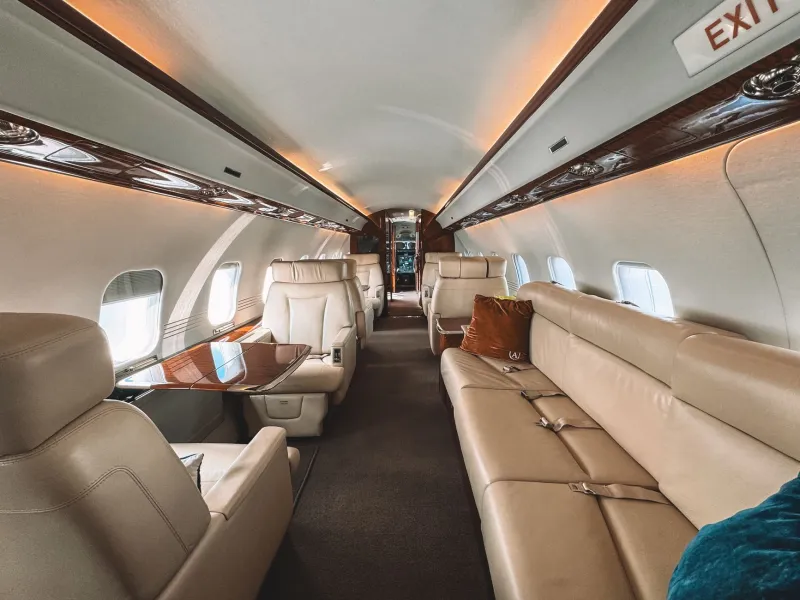
Private aviation restructures the entire pre-negotiation experience. Departures from fixed-base operators (FBOs) eliminate the mass-transit friction entirely. Cabins designed for rest and focus—with lie-flat seating, controlled acoustics, and the absence of strangers—allow executives to sleep, prepare, or simply decompress in a manner that preserves rather than depletes cognitive resources.
Perhaps equally significant is the element of schedule sovereignty. Commercial travel imposes its timeline on the traveler. Private aviation inverts this relationship. An executive who can depart when the deal demands, arrive the evening before rather than the morning of, and control every variable of the transit experience is an executive who walks into a room having spent no energy on logistics. That energy remains available for what actually matters.
Emotional regulation—the capacity to remain composed, strategic, and empathetic under pressure—is also meaningfully affected by arrival state. Executives who arrive rested and calm are better positioned to read nonverbal cues, absorb unexpected information without destabilization, and project the quiet confidence that sophisticated counterparts recognize and respect.
Real Leverage, Quietly Held
The competitive dimension of arrival state is rarely discussed openly, which may be precisely why it confers such durable advantage. In any negotiation, both parties are assessing each other from the first moment of contact. Posture, eye contact, the steadiness of voice, the speed and precision of responses—all of these signals are processed before formal terms are ever raised.
An executive who projects alertness and composure does not merely appear more credible. They functionally are more credible, because their cognitive architecture is operating closer to its capacity. They are more likely to catch an ambiguous clause, more capable of holding multiple competing interests in mind simultaneously, and more resistant to the manufactured urgency that skilled negotiators deploy to extract concessions.
Conversely, fatigue is a form of involuntary disclosure. An experienced counterpart does not need to be told that the person across the table is running on four hours of sleep and a mediocre airport breakfast. The signals are legible. And in a negotiation where every point of leverage matters, arriving depleted is, in effect, arriving with a weaker hand.
Reframing the Investment
For high-net-worth individuals and senior executives accustomed to measuring decisions in terms of return, the calculus around private aviation shifts considerably when arrival state is factored into the analysis. The question is no longer whether a charter flight costs more than a first-class ticket. The question is what a superior cognitive state is worth when applied to a transaction involving eight, nine, or ten figures.
Few executives would voluntarily enter a negotiation without adequate preparation. Fewer still would knowingly accept a structural disadvantage in the hours before a critical meeting. Yet that is precisely what commercial travel routinely delivers—not through malice, but through the accumulated friction of a system designed for volume, not performance.
Private aviation, at its most strategically considered, is not a reward for success. It is a condition of sustained performance. The cabin is not the destination. It is the preparation.
The Arrival Is Part of the Deal
The most effective negotiators understand that the work of a deal begins long before the first handshake. It begins with the decisions made about how to travel, when to arrive, and how to protect the cognitive and physiological resources that the negotiation will demand.
Walking into a room rested, composed, and operating at full mental capacity is not a luxury. It is a strategy. And in a landscape where the margins between winning and leaving value on the table are often measured in subtle moments of clarity or lapse, the executive who treats arrival condition as a competitive variable is already operating at a different level than the one who does not.
The negotiation, it turns out, begins the moment you decide how to get there.