Outsmarting the Clock: How Private Aviation Lets You Land in Sync With Your Biology
There is a particular cruelty to the way jet lag strikes the people who can least afford it. A senior executive crosses six time zones to close a nine-figure acquisition, steps off a commercial flight at 7:00 a.m. local time, and spends the first three hours of the most consequential day of the quarter fighting a neurological fog that no amount of espresso can fully dispel. The body insists it is 1:00 a.m. The boardroom insists it is showtime.
This is not a minor inconvenience. It is a structural competitive disadvantage — one that a growing number of ultra-high-net-worth travelers are eliminating through a discipline that might be called circadian flight planning.
The Science Behind the Fog
The human circadian system is governed primarily by the suprachiasmatic nucleus, a cluster of neurons in the hypothalamus that synchronizes the body's internal clock to environmental light cues. When you cross multiple time zones rapidly, this system does not update instantaneously. It lags — typically recalibrating at a rate of roughly one hour per day for eastward travel and slightly faster for westward movement.
The consequences extend well beyond fatigue. Research published in peer-reviewed journals on sleep medicine consistently demonstrates that circadian misalignment impairs working memory, executive function, emotional regulation, and decision-making speed — precisely the cognitive faculties that high-stakes negotiations demand. Studies examining shift workers and frequent long-haul travelers have found measurable reductions in prefrontal cortex activity during periods of acute circadian disruption.
For an executive whose hourly cognitive output represents hundreds of thousands of dollars in value, arriving even partially misaligned is a quantifiable loss.
Why Commercial Schedules Are Biologically Indifferent
Commercial aviation operates on a logic entirely divorced from human physiology. Departure times are dictated by gate availability, crew rotations, hub connectivity, and revenue optimization — none of which bear any relationship to a passenger's chronotype, sleep history, or the cognitive demands awaiting them at the destination.
The result is that a traveler flying from New York to Dubai on a commercial carrier may find that the only viable nonstop option departs at 11:00 p.m. and arrives at 7:00 p.m. local time — a schedule that, depending on the individual's sleep architecture and the nature of their commitments upon arrival, may be nearly optimal or profoundly counterproductive. The traveler has no input. The schedule is fixed.
Even in business class, where lie-flat seats offer genuine rest, the fundamental problem remains: the timing of sleep and wakefulness is constrained by when the aircraft happens to be in the air, not by when the passenger's biology is prepared to receive it.
The Private Aviation Advantage: Time as a Variable
For those who fly private, departure time is not a constraint. It is a design element.
This distinction is more consequential than it may initially appear. Circadian science has identified several key levers for minimizing jet lag: strategic light exposure at the destination, melatonin timing relative to the new sleep window, pre-departure sleep adjustment in the days before travel, and — critically — selecting a departure time that allows natural sleep to occur during the flight's appropriate phase of the journey.
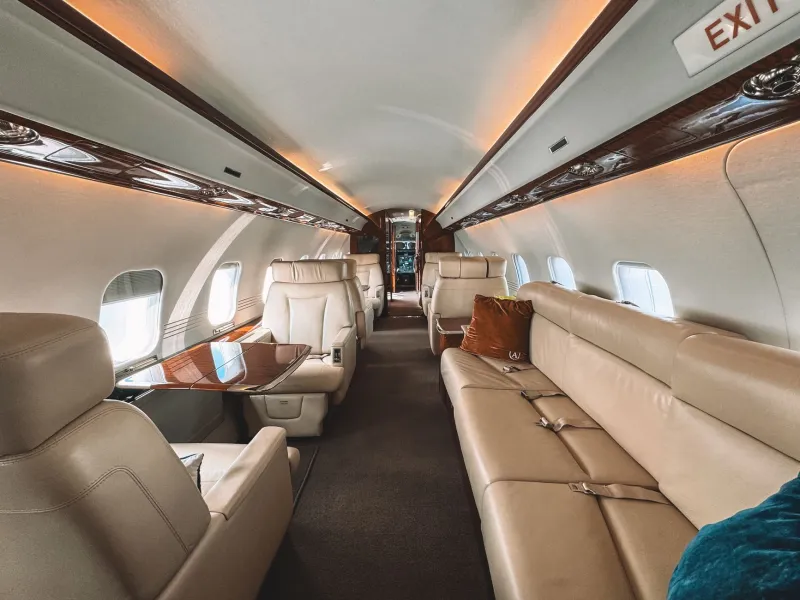
A private aviation client traveling from Los Angeles to London for a Monday morning meeting can work backward from the desired cognitive state at arrival and construct a flight itinerary around that endpoint. If the research suggests that sleeping from 10:00 p.m. to 6:00 a.m. London time is optimal for same-day performance, the aircraft can depart at a time that places those hours in the air, in a fully reclined cabin, in controlled lighting conditions, without the ambient noise and interruptions of a commercial cabin.
This is not a theoretical luxury. It is applied chronobiology.
Rest-Optimized Flight Planning in Practice
The most sophisticated private aviation operators have begun formalizing this approach. Flight planning teams at leading charter and fractional ownership providers now routinely consult with clients on circadian optimization as part of the pre-departure briefing process. Some ultra-high-net-worth travelers retain dedicated wellness advisors who coordinate with aviation teams to prescribe light therapy protocols, pre-flight sleep adjustments, and in-flight nutrition timing.
The aircraft itself becomes a tool in the strategy. Cabin altitude on many large-cabin private jets is maintained at a pressure equivalent of 4,000 to 6,000 feet — significantly lower than the 8,000-foot equivalent common on commercial widebodies. This reduced altitude differential means better oxygen saturation, lower physiological stress, and meaningfully improved sleep quality during the flight. Humidity levels, another factor in rest quality, can also be better managed in a private cabin.
When the flight concludes, the traveler does not emerge into a crowded terminal to collect luggage and negotiate ground transportation. They step directly into a waiting vehicle, having slept on a schedule calibrated to the demands of the day ahead.
Eastward Versus Westward: The Directional Calculus
Any serious approach to circadian flight planning must account for directionality. Eastward travel — New York to London, Los Angeles to Tokyo — is consistently harder on the human system than westward movement. The circadian clock naturally runs slightly longer than twenty-four hours, making it easier to extend a day than to compress one. Flying east forces compression.
For east-bound travelers, the private aviation advantage becomes even more pronounced. The ability to depart slightly earlier, capture a full sleep cycle during the transatlantic or transpacific crossing, and arrive during the destination's natural morning — rather than being deposited at an awkward hour by a schedule optimized for airline economics — can mean the difference between arriving functional and arriving compromised.
West-bound travel allows somewhat more flexibility, but the same principle applies: when departure time is a variable you control, you can engineer arrival conditions rather than merely endure them.
The Competitive Calculus
Among the world's most active global dealmakers, the conversation around private aviation has matured considerably. The discussion has moved beyond comfort and status — those factors are assumed — and into the territory of performance optimization. The question being asked in the offices of leading family offices, private equity firms, and multinational corporations is increasingly precise: how do we ensure that our principals arrive at maximum cognitive capacity, consistently, regardless of geography?
The answer, for those with the means and the strategic clarity to pursue it, runs through the flexibility that private aviation uniquely provides. Not the aircraft as a symbol of success, but the aircraft as an instrument of biological precision — a vehicle for arriving not just at a destination, but ahead of your own circadian rhythm.
In a world where the margin between a closed deal and a missed opportunity can be measured in hours, that is not a small advantage. It is a decisive one.