Speed as Strategy: How Private Aviation Rewrites the Rules of M&A Due Diligence

In the architecture of a major acquisition, most observers focus on the obvious variables: valuation multiples, debt structures, regulatory exposure, and management alignment. What rarely enters the conversation — yet frequently determines its outcome — is logistics. Specifically, who controls the timeline of due diligence, and how that control translates into leverage.
The executives who close the most consequential deals in American business are not necessarily the ones with the sharpest analysts or the most aggressive term sheets. They are, more often than not, the ones who can physically be in more places, in less time, with less cognitive residue from the journey itself. Private aviation is the infrastructure that makes that possible.
The Due Diligence Window Is Shorter Than It Appears
When a letter of intent is signed, a clock begins running — and it rarely runs in the buyer's favor. Sellers manage access strategically. Management teams are made available in carefully sequenced windows. Data rooms open and close on schedules designed to create urgency without enabling thoroughness. The buyer who cannot move fluidly between locations is, by definition, working at a disadvantage.
Consider the typical multi-site due diligence process for a mid-market industrial acquisition. A serious buyer needs to physically inspect manufacturing facilities in, say, Memphis, assess regional sales operations in Charlotte, and meet with the CFO's team in Chicago — all within a compressed window before a competing bid deadline. On commercial aviation, that itinerary requires two to three days minimum, involves three separate airports, and extracts a measurable toll on the decision-making capacity of everyone involved. On a private jet, the same itinerary is a single, well-orchestrated day.
That compression is not merely a matter of efficiency. It is a structural shift in who holds informational advantage.
Information Gathered Together Is More Powerful Than Information Gathered in Sequence
There is a dimension of due diligence that financial models do not capture: the interpretive value of context. When a senior deal team visits three facilities on the same day, they carry their observations from each stop into the next conversation. A discrepancy noticed in Memphis sharpens the questions asked in Charlotte. An inconsistency surfaced in Charlotte reframes the financial review in Chicago.
When that same process is stretched across multiple days — with commercial flights, hotel stays, and the inevitable logistical friction of terminal-to-terminal travel in between — the interpretive thread frays. Details that would have connected do not. Patterns that would have emerged remain obscured. The deal team arrives at its final meeting carrying less cumulative insight than it should.
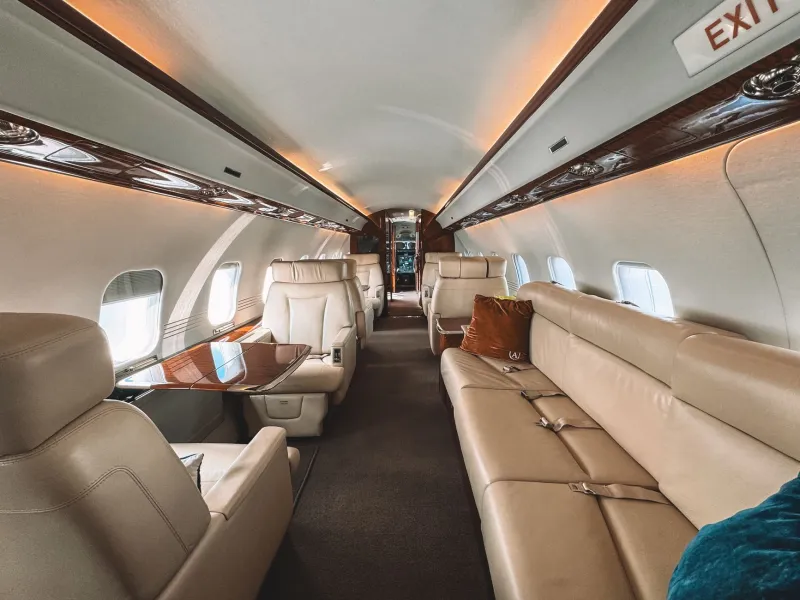
Private aviation eliminates that degradation. The cabin becomes a mobile conference room between stops, allowing the team to debrief in real time, refine their analysis, and arrive at the next site sharper than when they left the last one.
Psychological Leverage and the Perception of Capability
Beyond the operational advantages, there is a subtler dimension worth examining: the signal that private aviation sends to the other side of the table.
Sellers and their advisors are sophisticated readers of buyer behavior. When a prospective acquirer arrives via chartered aircraft, conducts a rigorous site visit, and departs with the visible efficiency of a team that controls its own schedule, it communicates something that no term sheet can: this buyer is serious, well-resourced, and operating from a position of strength.
Conversely, a buyer who is visibly constrained by commercial flight schedules — who needs to leave early to catch a connection, who arrives fatigued from a 5:00 a.m. departure, who cannot accommodate a last-minute request to extend a facility tour — signals vulnerability. In negotiations where perception shapes reality, that signal carries real cost.
Several senior M&A advisors at major US investment banks have noted, informally, that the logistical posture of a buyer's team during due diligence often functions as an early indicator of deal conviction. Teams that move with fluency and control tend to close. Teams that appear logistically constrained tend to either lose to competitors or arrive at the table with diminished credibility.
The Competitor Who Moves Faster Defines the Terms
In competitive deal processes — which represent the majority of significant transactions in the current market — the ability to complete due diligence faster than competing bidders creates a compounding advantage. The buyer who finishes first has more time to refine its model, negotiate structural protections, and engage with financing sources. It also has the option to move to exclusivity before competitors have completed their own review.
Exclusivity, in M&A, is not a formality. It is a decisive shift in leverage. Once a seller enters exclusive negotiations with a single buyer, the competitive pressure that has been driving price and terms largely evaporates. The buyer who gets there first — often by virtue of superior logistical execution — frequently ends up with a more favorable transaction than the buyer who arrived second with a marginally better initial bid.
Private aviation is one of the few tools available to a deal team that directly compresses the timeline from LOI to exclusivity. It does not replace analytical rigor or relationship capital. But it removes the logistical friction that so often causes capable teams to move slower than their ambition demands.
Rethinking the Cost of Flying Private on a Deal
For executives accustomed to evaluating expenditures against direct returns, the calculus of private aviation during an M&A process deserves a specific kind of scrutiny. The question is not whether a charter flight is expensive in absolute terms. The question is what that flight is worth relative to the transaction it is enabling.
On a $200 million acquisition, the difference between winning and losing — or between acquiring at a favorable multiple versus an inflated one — is measured in tens of millions of dollars. The logistical investment required to compress due diligence timelines and arrive at every meeting in optimal condition is, by that measure, among the highest-return line items in the deal budget.
The executives who have internalized this arithmetic tend to approach private aviation not as a comfort consideration, but as a deal infrastructure decision — as deliberate and as consequential as the choice of legal counsel or financial advisor.
The Quiet Advantage That Rarely Appears in Deal Post-Mortems
When major transactions are later analyzed — in board presentations, investor communications, or business school case studies — the strategic and financial dimensions receive the most attention. The logistical factors that shaped execution rarely appear in the narrative.
But among the dealmakers themselves, the understanding is clear: in a market where information, timing, and perception all determine outcomes, the executive who controls the physical dimension of due diligence holds an advantage that is invisible to outside observers and deeply consequential to the people in the room.
Private aviation does not close deals. But it creates the conditions under which the best deals get closed — by the teams that arrive first, think clearest, and project the kind of composed capability that sophisticated counterparties recognize and respect.