Before the Handshake: How Private Aviation Reshapes the Psychology of High-Stakes Negotiations

There is a moment, familiar to any seasoned dealmaker, that occurs roughly forty minutes before a negotiation begins. It is the moment when the mind either sharpens into focus or quietly surrenders to the accumulated friction of the journey that preceded it. For executives who fly commercial, that moment is often compromised before they even reach the conference room door. For those who fly private, it is something else entirely — a deliberate, protected interval of preparation that the other side of the table may not have had.
The distinction is not incidental. It is strategic.
The Invisible Toll of Commercial Travel on Negotiating Capacity
Consider the standard itinerary for a senior executive traveling from New York to Chicago for a morning meeting with a prospective acquisition target. The commercial route demands an early car service to JFK or LaGuardia, a TSA checkpoint that strips both dignity and time, a gate area shared with several hundred strangers, and a boarding process that — on a good day — deposits the traveler in a narrow seat beside someone they did not choose. By the time the flight lands, the executive has spent two to three hours in an environment engineered for volume, not clarity.
The research on cognitive depletion is consistent: environments characterized by noise, unpredictability, and sensory crowding erode executive function — the precise mental faculty that governs strategic reasoning, impulse regulation, and persuasive communication. These are not peripheral skills in a negotiation. They are the negotiation.
The executive who arrives having navigated that gauntlet is not the same person who left the office the evening before. The degradation is subtle enough to go unnoticed, but measurable enough to matter.
Controlled Environments, Controlled Outcomes
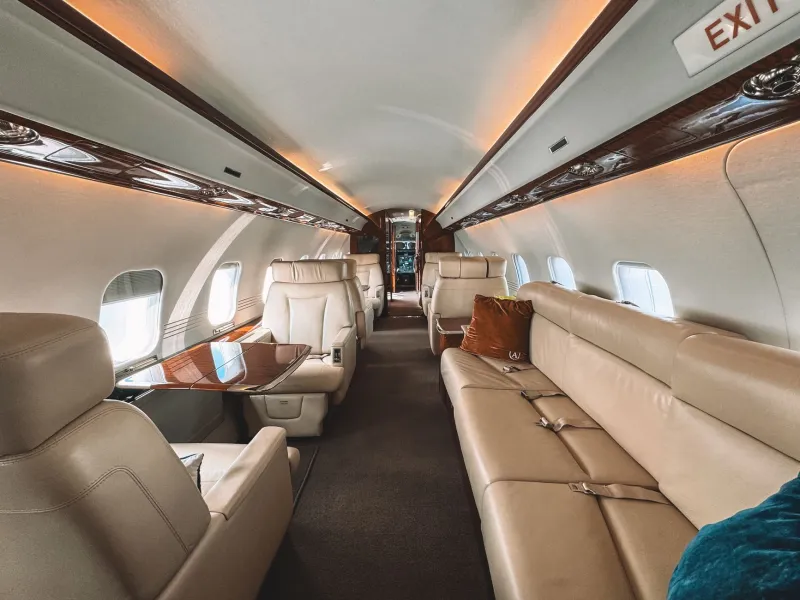
Private aviation eliminates the gauntlet. The FBO terminal — the fixed-base operator facilities used by private flyers — is a fundamentally different environment from any commercial terminal in the country. There is no line. There is no theater of security. There is a brief, professional check-in process, and then there is the aircraft.
What happens between the FBO and the destination is entirely within the traveler's control. Calls can be made without concern for eavesdropping. Documents can be reviewed without the risk of a neighboring passenger reading sensitive materials. The cabin can be configured for focused work, for rest, or for a structured pre-meeting briefing session with colleagues. The noise level is chosen, not imposed.
This matters in ways that extend beyond comfort. Preparation quality directly influences negotiation performance. The executive who has spent the flight reviewing the counterparty's recent earnings calls, stress-testing term structures, and mentally rehearsing their opening position arrives at the table with a material advantage — not because they are more intelligent, but because they have been permitted to think.
Privacy as a Negotiating Asset
There is another dimension to this advantage that rarely appears in discussions of private aviation: information security. Commercial flights are, by their nature, porous environments. Conversations are overheard. Screens are visible. The identity of a recognizable executive traveling to a particular city on a particular day is itself a piece of intelligence that can be noted, shared, and acted upon.
In markets where deal rumors move prices and where competitive intelligence is actively cultivated, the act of flying commercial is a form of inadvertent disclosure. Private terminals, by contrast, offer a level of discretion that commercial infrastructure cannot match. Departures are not broadcast. Passenger manifests are not public. The destination remains, for all practical purposes, unknown to anyone who was not meant to know it.
For a negotiator working on a sensitive acquisition, a strategic partnership, or a restructuring that has not yet been announced, that privacy is not a luxury. It is a prerequisite.
The Physiological Reset
Beyond cognition and security, there is the matter of physical presentation — a factor that negotiators frequently underestimate. Body language, vocal tone, and the subtle signals of fatigue or composure are read, consciously and unconsciously, by everyone in the room. The executive who has slept poorly on a red-eye, whose posture reflects hours in a cramped seat, and whose voice carries the hoarseness of recycled cabin air does not project the same authority as one who arrived rested, prepared, and physically at ease.
This is not vanity. It is biomechanics. The physiological state of a negotiator influences how they are perceived, how they perceive others, and how readily they access the emotional regulation required to hold a position under pressure. Private aviation preserves that state in ways that commercial travel structurally cannot.
One managing partner at a mid-market private equity firm described the shift this way: flying private to a deal meeting is not about arriving in style — it is about arriving as yourself, rather than as a diminished version of yourself that has been processed through three hours of institutional friction.
The Strategic Calculus
For high-net-worth executives who evaluate decisions through the lens of return on investment, the arithmetic of private aviation becomes straightforward when applied to high-stakes negotiations. The fee for a charter flight between two major US cities is a fixed cost. The value of the transaction being negotiated is often orders of magnitude larger. The question is not whether private aviation is expensive — it is whether the edge it confers is worth the cost relative to what is at stake.
In most serious deal contexts, the answer is not close.
The counterparty who arrives depleted, distracted, and informationally exposed is not an equal negotiator, regardless of how talented they are. The executive who controls their travel environment controls their mental state. The executive who controls their mental state controls the room.
A Different Kind of Preparation
JetRest was built on the premise that how you travel is inseparable from how you perform. The private aviation ecosystem — from charter operators to fractional programs to full ownership structures — exists not merely to deliver passengers from one city to another, but to deliver them in a condition worthy of what awaits them on the ground.
For the negotiator who understands that the deal begins before the handshake, that preparation is not a formality but a competitive act, and that every hour of travel is either an investment or a liability, the choice of how to fly is not a lifestyle decision. It is a professional one.
The most consequential negotiations in American business are not won at the table. They are won in the hours before the table is reached. Private aviation is the infrastructure that makes those hours count.