The Quiet Edge: How Eliminating Airport Friction Compounds Into Sharper Decisions and Greater Returns
There is a persistent assumption embedded in the culture of American business: that working harder, and working more visibly, is the surest path to superior results. It is an assumption that has survived decades of productivity research largely intact — and it is, in many respects, wrong.
For the executive class, nowhere is this misapprehension more consequential than in how they choose to travel. The conventional wisdom holds that flying commercial, particularly in premium cabins, is an acceptable trade-off — a modest inconvenience absorbed in the name of fiscal prudence. What this calculus consistently fails to account for is the hidden tax that commercial aviation imposes on cognitive performance, and the compounding cost of that impairment across the hours and days that follow.
Private aviation, examined through this lens, reveals itself not as an indulgence but as a mechanism for doing less while producing more.
The Friction Tax Nobody Talks About
Consider what a standard commercial itinerary actually requires of a senior executive before the aircraft ever leaves the gate. There is the arrival window — typically ninety minutes to two hours ahead of departure for domestic flights, longer for international. Security theater, gate changes, boarding sequences, and the ambient chaos of a major hub all precede the flight itself. Once airborne, the environment is one of managed discomfort: constrained movement, unpredictable noise, the proximity of strangers, and the near-total absence of genuine privacy.
None of this is catastrophic in isolation. Cumulatively, however, it constitutes what cognitive scientists refer to as ego depletion — the gradual erosion of the mental resources required for high-order thinking. By the time a commercially-traveled executive arrives at their destination, they have already spent a meaningful portion of their cognitive budget simply navigating the journey.
The irony is that this expenditure is largely invisible. Executives rarely attribute a suboptimal negotiation outcome, a missed nuance in due diligence, or a failure of creative synthesis to the exhaustion accumulated in Terminal B. They attribute it to the deal itself. The variable that most influenced the result — the condition of the decision-maker — goes unexamined.
What Recovery in Transit Actually Looks Like
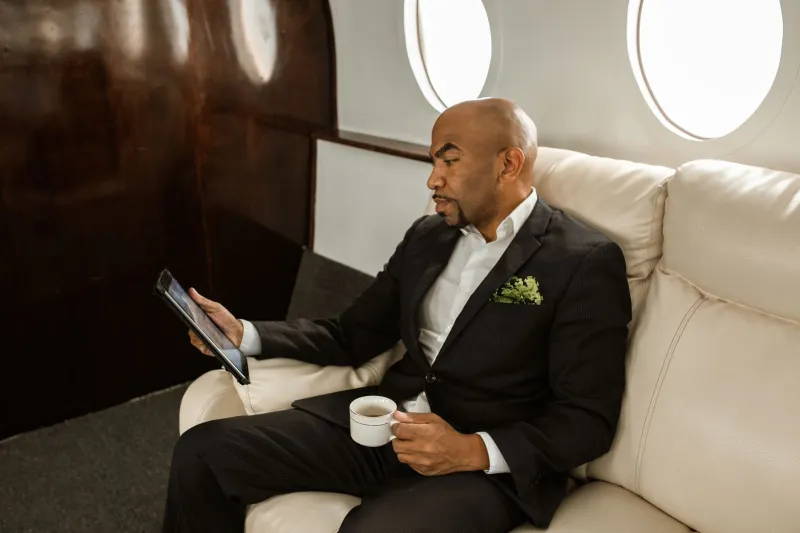
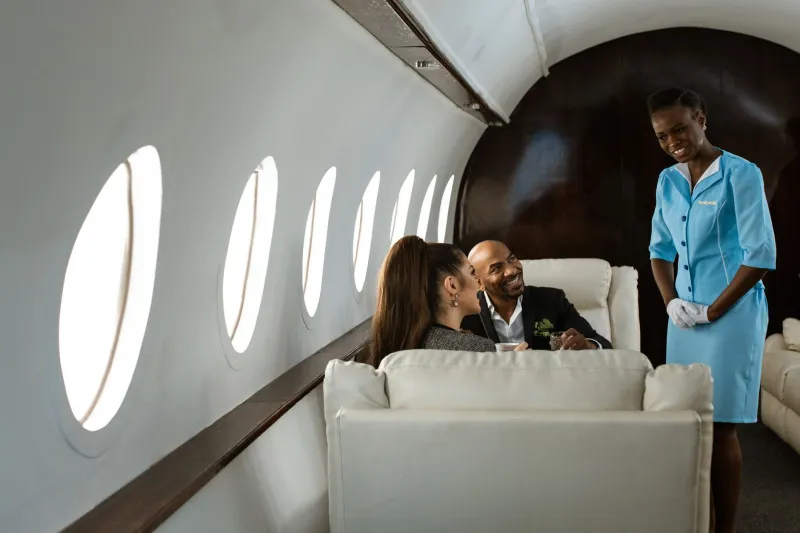
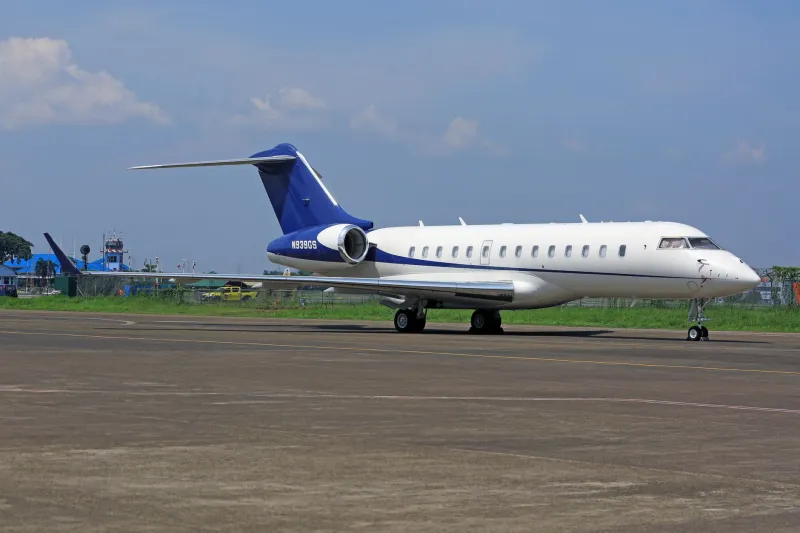
The private aviation experience inverts this dynamic at nearly every point of contact. Departure from a fixed-base operator, or FBO, eliminates the terminal entirely. The process from car door to cabin door is measured in minutes, not hours. The aircraft itself is a controlled environment — acoustically manageable, spatially generous, and entirely private.
This is not merely more comfortable. It is neurologically restorative in a way that commercial transit is not.
Sleep researchers and performance psychologists have long documented the relationship between autonomic nervous system regulation and executive function. When the body is not required to sustain a low-grade stress response — which is precisely what crowded, unpredictable environments reliably trigger — it allocates resources differently. Prefrontal cortex activity, which governs judgment, risk assessment, and strategic thinking, operates more effectively when the threat-response systems are quiet.
An executive who boards a private aircraft, settles into a familiar and controlled environment, and either rests or works without interruption arrives at their destination in a fundamentally different neurological state than one who has navigated a commercial hub. The gap between these two states is not trivial. In high-stakes contexts — a board presentation, a term sheet negotiation, a relationship-defining client meeting — it can determine the outcome.
The Quantified Advantage
Several executives who have made the transition from commercial to private travel describe the change in terms that go beyond comfort. A managing partner at a mid-market private equity firm based in Chicago recounted restructuring his travel pattern to fly private for any engagement where the first meeting would occur within four hours of landing. His reasoning was straightforward: he had identified a pattern in which his early-meeting performance on commercial travel days was consistently weaker than on days when he had driven or flown private. The variable was not preparation. It was arrival state.
A technology entrepreneur who relocated from San Francisco to Miami and maintained significant business interests on both coasts described a similar recalibration. After tracking his deal conversion rates informally over eighteen months, he concluded that the meetings he attended within a day of cross-country commercial travel had a materially lower close rate than those preceded by either a private flight or an overnight recovery. He began scheduling commercial trips to allow for a full night of sleep before any consequential engagement — and eventually migrated the majority of his travel to charter.
These accounts are not scientific studies. But they reflect a pattern of reasoning that sophisticated executives increasingly apply to their own performance data: the quality of arrival matters, and the mode of transit is among its primary determinants.
Less Time Traveling, More Time Performing
The paradox at the center of this discussion is not actually a paradox at all, once the full picture is visible. Executives who fly private do not simply save time in the narrow sense — though they do that too, often recapturing two to four hours per trip that would otherwise be consumed by airport logistics. They save a different and more valuable resource: cognitive capacity.
An hour of deep-focus strategic thinking, available because the executive arrived rested and unencumbered, is worth considerably more than the same hour spent in a state of travel-induced depletion. The math, applied across a year of frequent travel, produces a meaningful asymmetry in output quality — and, by extension, in outcomes.
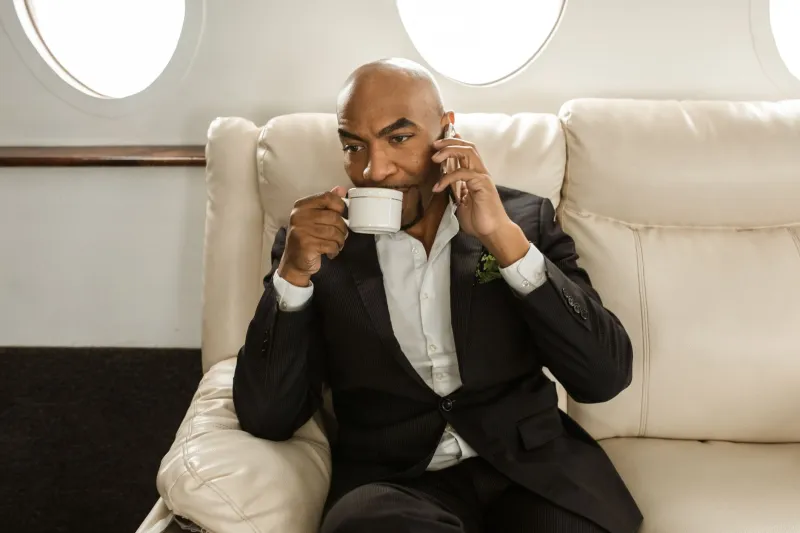
There is also the matter of what private aviation enables during the flight itself. The cabin of a well-appointed private aircraft is among the few genuinely private environments available to a senior executive in transit. Calls can be conducted without concern for who is listening. Documents can be reviewed without the anxiety of shoulder surveillance. Preparation for the meeting ahead can proceed with full concentration. Some executives use the flight not for work at all, but for deliberate rest — a choice that is equally strategic, and equally unavailable on a commercial aircraft without significant compromise.
Rethinking the Economics of How You Travel
The financial case for private aviation is often framed as a comparison of ticket prices. This is the wrong unit of measurement. The relevant comparison is between the total value generated by an executive operating at full capacity and the value generated by the same executive operating at a meaningful fraction of that capacity.
When private aviation is understood as a performance input rather than a travel amenity, its cost-benefit profile shifts considerably. For executives whose decisions regularly involve eight-figure or nine-figure consequences, the marginal improvement in cognitive performance that private travel reliably delivers is not a luxury — it is a leverage point.
The executives who have internalized this framework tend to describe a common realization: they are not flying private because they can afford to. They are flying private because, given what they are responsible for, they cannot afford not to.
At JetRest, this is the premise that underlies everything we publish about private aviation: that the highest return on this investment is not measured in comfort, but in clarity — and that clarity, applied consistently at the moments that matter most, is what separates exceptional performance from merely adequate results.