The Altitude of Discretion: How Private Aviation Protects the Conversations That Define a Family's Financial Legacy
There is a particular category of conversation that resists scheduling. It cannot be placed on a shared calendar, delegated to a conference call, or adequately held over a restaurant table. It involves the disposition of significant wealth, the future governance of closely held enterprises, and the often unspoken tensions that accompany any discussion of who receives what — and when. For American families managing nine-figure estates, operating companies, or multigenerational trusts, these conversations are among the most consequential they will ever have. And yet the environments available to them are, almost universally, inadequate.
Private aviation changes that calculus entirely.
The Surveillance Problem That No One Discusses Openly
Commercial aviation has become a remarkably porous environment. Beyond the well-documented risks of unsecured public Wi-Fi — which security professionals have long warned can expose sensitive communications to interception — there is the more fundamental problem of proximity. In any commercial cabin, regardless of class, a family patriarch discussing trust structures with an estate attorney is separated from strangers by inches of pressurized air. The same applies to a founder walking two adult children through a buy-sell agreement, or a matriarch explaining the terms of a charitable remainder trust to heirs who are hearing the details for the first time.
These are not paranoid concerns. They are the reasonable precautions of families who understand that information about wealth transitions — who stands to inherit, how assets are structured, which family members hold controlling interests — is precisely the kind of intelligence that sophisticated bad actors seek. The exposure is not hypothetical. It is architectural.
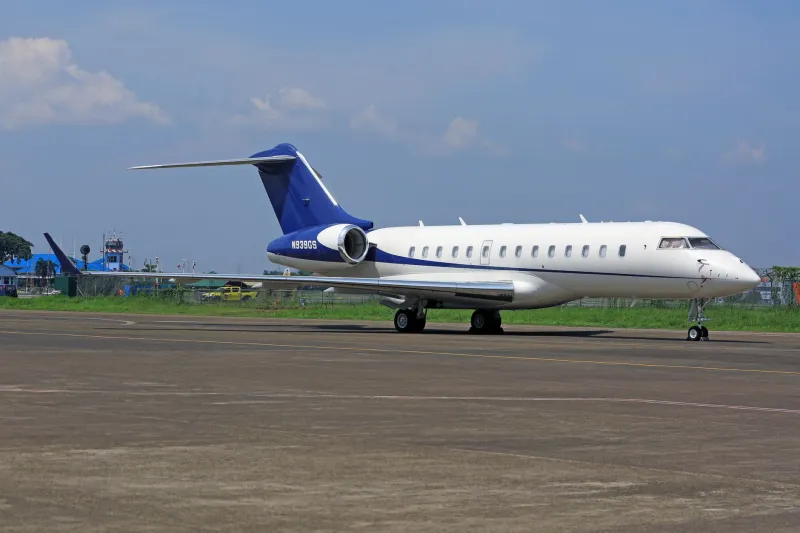
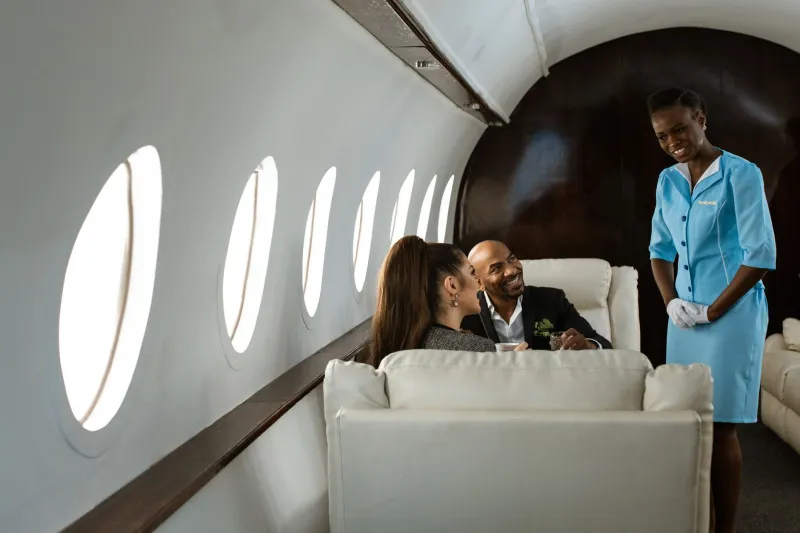
A private aircraft eliminates that architecture entirely. The cabin is occupied solely by those who have been deliberately invited. The communications infrastructure — whether satellite-connected or intentionally kept offline — is controlled by the operator, not shared with hundreds of other passengers on a carrier network. The conversation that needs to happen can happen without the ambient awareness that someone, somewhere, might be listening.
Why Altitude Creates the Conditions for Honest Dialogue
Beyond the security dimension, there is something less quantifiable but equally important about the psychological environment of a private cabin at cruising altitude. Practitioners in family wealth advising — attorneys, family office executives, private bankers — have long observed that certain conversations are easier to have when the parties are genuinely removed from their ordinary environments.
The mechanism is not mysterious. When a family boards a private aircraft together, the ordinary pressures of their individual lives — the notifications, the staff interruptions, the social obligations of being seen in a particular location — are suspended. There is no exit. There is no distraction that feels more urgent than the conversation at hand. For multi-generational stakeholders who may live in different cities, operate in different professional spheres, and rarely occupy the same room simultaneously, the cabin becomes something rare: a shared, bounded space with no competing claims on anyone's attention.
This matters enormously when the subject is succession. Estate planning and wealth transfer are not purely legal or financial exercises. They are, at their core, exercises in family communication. The most elegantly structured trust document is worth very little if the family members it governs do not share a common understanding of its intent. The aircraft cabin — insulated, unhurried, and free from the social performances that accompany meetings held in formal professional settings — creates conditions in which that understanding can actually be built.
Logistics as Strategy: Assembling the Right Stakeholders
One of the underappreciated advantages of private aviation in the context of family wealth transitions is purely logistical. A founding generation may be based in Texas. The eldest child may have relocated to New York for a career in finance. A second child may manage the family's agricultural holdings from a property in Montana. The family's primary estate attorney practices in Chicago. The trust and tax advisors are in Los Angeles.
On commercial aviation, assembling these stakeholders in a single location requires each party to navigate their own routing, their own layovers, and their own schedules — a coordination challenge that frequently results in the conversation being deferred, abbreviated, or fragmented across multiple separate meetings that never quite achieve the coherence of a single sustained dialogue.
A private aircraft resolves this entirely. The family can fly together from a home base, collecting advisors along the way if the aircraft and routing permit, or conduct the conversation among family members before landing to meet the professional team. The journey itself becomes a structured opportunity — a pre-meeting that allows the family to arrive at the formal advisory session with a degree of internal alignment that would otherwise take weeks of separate phone calls to approximate.
The Document Risk That Families Routinely Underestimate
Succession planning generates paper — or, increasingly, digital documents — of exceptional sensitivity. Draft wills, preliminary trust agreements, family governance charters, buy-sell term sheets, and asset schedules are routinely shared among family members and advisors in advance of key meetings. On commercial travel, the handling of these documents presents risks that are rarely acknowledged.
A laptop screen displaying a family balance sheet is visible to any adjacent passenger willing to look. A printed document left in a seat pocket, even briefly, is a document that has left the family's control. The casual use of airline Wi-Fi to transmit a revised estate plan to an attorney is a transmission that may pass through networks of entirely unknown security integrity.
Within a private cabin, none of these risks apply in the same way. Documents can be reviewed openly. Screens can be shared among participants without concern for who is positioned in the next row. Sensitive materials can be discussed verbally without the discipline of near-whisper that commercial travel imposes. The family is, in the fullest sense, in possession of their own information environment.
A Platform Built for Decisions That Cannot Be Undone
The decisions made in succession planning are among the most durable a family will ever make. A trust structure established today may govern the distribution of wealth across three or four generations. A governance agreement signed this year may determine who controls the family enterprise for the next two decades. These are not decisions that benefit from haste, distraction, or the low-grade anxiety that commercial travel reliably produces.
Private aviation does not make these decisions easier in any simplistic sense. The emotional complexity of wealth transfer — the sibling dynamics, the competing visions for a family enterprise, the grief that sometimes underlies the practical — does not dissolve at altitude. What private aviation provides is something more precise: the conditions under which those complexities can be engaged honestly, without the compounding pressures of an inadequate environment.
For American families managing significant wealth across generations, the aircraft is not an indulgence. It is, in the most literal sense, the room where the most important conversations happen. Choosing that room carefully is simply an extension of the same discipline that built the wealth in the first place.