Neurologically Compromised Before You Sit Down: What Your Travel Itinerary Is Doing to Your Deals

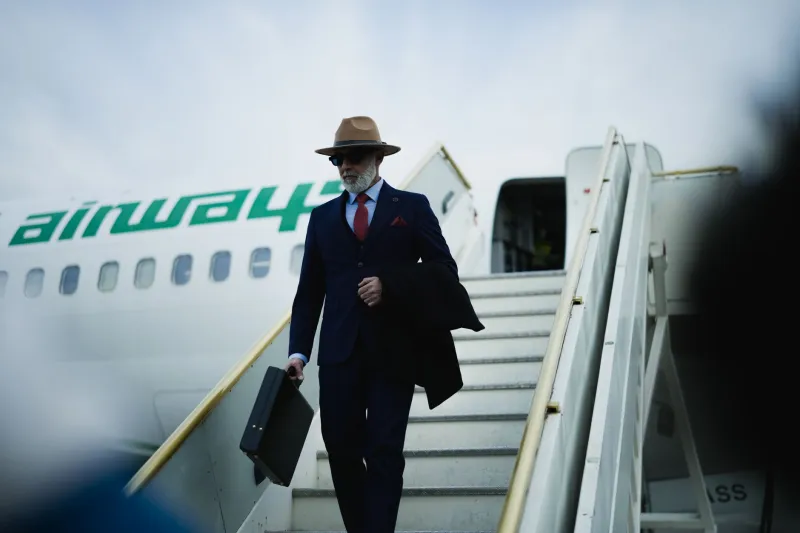
Photo by Photo by noey tm on Unsplash on Unsplash
There is a negotiation that begins long before the conference room fills, long before term sheets are distributed, and long before anyone has uttered a single opening position. It takes place in airports, middle seats, and security lines. It is conducted not between opposing parties but between your nervous system and the cumulative indignities of commercial travel—and by the time you arrive, it has already registered a verdict.
For high-net-worth executives and dealmakers who move capital at scale, this invisible negotiation deserves the same rigorous analysis applied to any other strategic variable. The evidence, increasingly drawn from cognitive neuroscience and behavioral economics, is unambiguous: how you travel to a deal materially influences how you perform within it.
What Stress Does to the Negotiating Brain
The prefrontal cortex—the region of the brain responsible for judgment, impulse control, long-range planning, and nuanced social interpretation—is exquisitely sensitive to cortisol, the body's primary stress hormone. When cortisol levels rise, as they reliably do during the friction-laden experience of commercial air travel, prefrontal function degrades measurably. The result is not dramatic incapacitation. It is something far more dangerous: subtle impairment that the individual cannot self-detect.
Research published in peer-reviewed journals on cognitive performance consistently demonstrates that elevated stress reduces working memory capacity, narrows attentional bandwidth, and increases susceptibility to cognitive shortcuts—the same shortcuts that cause experienced negotiators to anchor too readily, concede too early, or misread the emotional register of a counterpart. You do not feel impaired. You feel tired, perhaps slightly irritable. But the neural architecture supporting your best thinking has been quietly compromised.
Add sleep disruption from a redeye connection, dehydration from recycled cabin air, and the cortisol spike triggered by a missed connection or a gate change, and you have not merely an uncomfortable traveler. You have an executive operating at a measurable cognitive deficit, walking into a room with people who may have arrived by very different means.
The Asymmetry No One Discusses
Here is where the competitive dimension becomes impossible to ignore. In any negotiation of consequence, the parties at the table are rarely in equivalent physiological states. One side may have chartered a flight from Teterboro, spent the journey reviewing materials in a quiet cabin, eaten a proper meal, and arrived at the hotel with time to decompress. The other may have endured a connection through O'Hare, absorbed two hours of gate delays, and grabbed a protein bar somewhere between the TSA checkpoint and the Uber.
These are not equivalent conditions. And the research on decision fatigue—pioneered by social psychologist Roy Baumeister and extended by subsequent scholars—confirms that the quality of decisions degrades with each taxing experience that precedes them. By the time an executive who has navigated a commercial itinerary reaches the negotiating table, they have already spent significant cognitive reserves simply managing the journey. Their counterpart who arrived rested has not.
This asymmetry is rarely acknowledged in post-mortems. When a deal closes on less favorable terms than anticipated, the analysis typically focuses on market dynamics, leverage differentials, or preparation quality. Almost never does it examine the neurological state of the principals at the moment of decision. Yet the evidence suggests it should.
Case Dynamics: When Arrival Conditions Changed the Math
Consider the structural logic of a scenario that plays out with regularity across American boardrooms. A private equity principal flies commercial from New York to Dallas for a final-round acquisition discussion. The flight is delayed. The connection is tight. He arrives at the hotel at midnight, sleeps poorly, and presents himself at 9 a.m. having consumed two cups of hotel coffee and a granola bar. His counterpart—the founder of the target company—slept in his own bed, drove twenty minutes to the meeting, and is operating from a baseline of genuine composure.
The negotiation that follows is not between equals, regardless of what the term sheet says. The sleep-deprived acquirer is more likely to accept an anchor number without sufficient resistance, more likely to interpret ambiguous signals from the founder as hostile rather than strategic, and more likely to make concessions in the early rounds that compound unfavorably through the remainder of the discussion. The founder, without doing anything explicitly tactical, benefits from a structural advantage he may not even be aware of.
Now reverse the conditions. The private equity principal arrives via charter, having used the flight to review comps, eat a real meal, and engage in a forty-minute conversation with his deal team without the ambient noise of a commercial cabin. He checks into the hotel at a reasonable hour, sleeps well, and arrives at the meeting having already rehearsed his opening position aloud. The negotiation that follows is substantively different—not because of what he says, but because of the neural resources available to him when he says it.
The Preparation Paradox
American executives invest extraordinary resources in deal preparation. Legal teams spend weeks conducting due diligence. Financial advisors model scenarios across hundreds of variables. Communications consultants rehearse messaging. And then, with all of that preparation in place, the principal boards a commercial flight that systematically degrades the very cognitive capacity required to deploy it.
This is the preparation paradox: the investment in readiness is undermined by the conditions of arrival. It is the equivalent of training rigorously for a marathon and then running the final mile in dress shoes. The preparation was real. The interference is equally real.
Private aviation dissolves this paradox not by adding comfort—though the comfort is genuine—but by preserving the integrity of the preparation itself. When the journey is controlled, quiet, and physiologically benign, the executive who arrives is the same executive who prepared. The work done in the weeks preceding the meeting is not eroded by the hours immediately preceding it.
Reclassifying the Investment
For executives accustomed to evaluating every expenditure through a return-on-investment lens, private aviation has often been categorized as a luxury line item—defensible, perhaps, but not strategic. That classification is increasingly difficult to sustain when examined against the neuroscience.
If the difference between arriving rested and arriving depleted is measurable in terms of negotiating performance, and if that performance differential translates into even marginally better deal terms on transactions worth tens or hundreds of millions of dollars, then the economics of private aviation are not a luxury calculation. They are a leverage calculation.
The most sophisticated dealmakers in the United States have already internalized this logic. They do not fly private because they have earned the right to comfort. They fly private because they understand that the invisible negotiation—the one that happens in transit—is one they cannot afford to lose.
The question worth asking, before your next high-stakes meeting, is not whether you can justify the investment. It is whether you can afford to arrive any other way.