The Blank Hours: Why the Most Effective Dealmakers in America Deliberately Fly to Nowhere

There is a particular kind of discipline that does not appear on any calendar. It generates no deliverables, produces no minutes, and cannot be explained in a quarterly review. Yet among a growing cohort of elite American executives—those who operate at the intersection of significant capital, compressed timelines, and unrelenting consequence—it has become one of the most jealously protected assets in their professional lives.
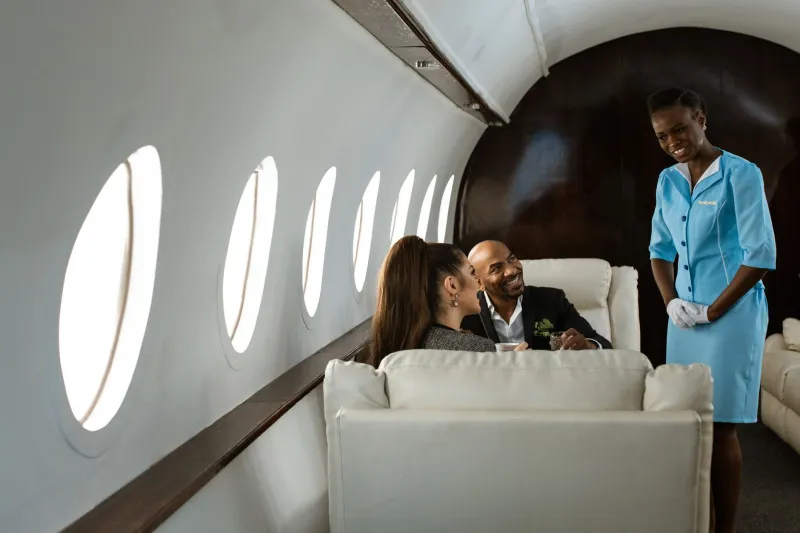
They call it, informally, the blank flight. A private cabin. No calls. No briefings. No preparation materials. Just altitude, silence, and the deliberate surrender of productivity in service of something far more valuable: the restoration of the cognitive machinery that makes every subsequent decision worth making.
The Decay Nobody Schedules For
Decision quality is not a fixed resource. Every cognitive demand placed on the human brain—every negotiation, every judgment call, every interpersonal calibration—draws from a finite neurological reserve that does not replenish simply because the calendar advances to the next item.
Research in cognitive psychology has long documented this phenomenon under the clinical term ego depletion, though its practical implications extend well beyond academic literature. When an executive concludes a demanding morning negotiation in, say, Chicago, boards a commercial flight to New York for an afternoon board engagement, and arrives having spent three hours in a crowded terminal and a pressurized cabin full of ambient noise and strangers, they are not arriving as the same person who closed the morning meeting. They are arriving as a measurably diminished version—one whose risk tolerance has shifted, whose pattern recognition has dulled, and whose capacity for nuanced interpersonal reading has contracted.
The problem is not travel. The problem is the absence of genuine recovery between demands.
What Recovery Actually Requires
The concept of rest is routinely misunderstood in high-performance professional culture. Rest is not sleep, though sleep is one component of it. Rest, in the neurological sense, is the cessation of directed cognitive effort—the withdrawal of the prefrontal cortex from active problem-solving, social monitoring, and executive function.
This kind of rest cannot be achieved in a commercial first-class cabin where the passenger in the adjacent seat is conducting a phone call, where the flight attendant is offering a beverage service every forty minutes, and where the ambient environment constantly signals to the brain that it must remain alert and socially engaged. The commercial aviation environment is, by design, a public space. It is governed by shared norms, managed interruptions, and a persistent low-grade social demand that the nervous system cannot fully ignore.
Private aviation removes that demand entirely. The cabin is a controlled environment, customizable to the individual's specific recovery requirements. Some executives darken the windows and recline in silence. Others engage in non-directed reading—material with no bearing on their current deal cycle—allowing the mind to wander without agenda. A smaller number use the time for what psychologists call diffuse thinking: the unfocused cognitive state that, paradoxically, produces some of the most sophisticated problem-solving the brain is capable of.
The mechanism matters less than the outcome: a nervous system that has been genuinely stood down, rather than merely rerouted.
The Strategic Architecture of the Blank Flight
For executives who have integrated this practice, the blank flight is not an accident or an indulgence. It is a scheduled intervention, built into the travel itinerary with the same intentionality as the meetings it brackets.
The structure typically follows a recognizable pattern. A high-stakes engagement concludes. Rather than immediately transitioning to preparation for the next one, the executive boards their aircraft and instructs the team—both on the ground and in the air—that the flight duration is unscheduled. No briefings are loaded. No calls are patched through. The aircraft departs, and for the duration of the flight, the executive exists outside the operational tempo of their professional life.
Upon landing, the reengagement is deliberate and graduated. A brief review of the next meeting's key variables. A single call with a trusted advisor, if warranted. Arrival at the destination with what experienced dealmakers describe as a kind of reset clarity—the cognitive equivalent of a clean slate, brought to bear on a fresh set of stakes.
Commercial aviation cannot accommodate this architecture. Its schedules are fixed, its environments are shared, and its implicit contract with the traveler is one of managed transit rather than personalized recovery. The executive who flies commercially between consecutive high-pressure engagements is not choosing efficiency. They are choosing to arrive at their next meeting already behind.
The Compounding Logic
The case for blank flight time becomes considerably more compelling when examined across the arc of a demanding week rather than a single day.
Consider the executive who conducts four significant negotiations across three cities over five days. Each engagement draws on the same cognitive reserves. Each commercial transit partially depletes those reserves further through the friction of terminals, security queues, and shared cabin environments. By the fourth meeting, the executive is operating on a fraction of the capacity they brought to the first.
Now consider the same schedule executed through private aviation with deliberate recovery intervals built between each engagement. The neurological math changes entirely. Each flight becomes a restoration window rather than an additional stressor. The fourth meeting receives something close to the same quality of attention as the first.
Over the course of a career defined by high-stakes decisions, the compounding effect of that differential is not trivial. It is, arguably, one of the most significant performance advantages available to any professional operating at this level.
Silence as Infrastructure
There is a tendency in American business culture to equate busyness with effectiveness, and to view unscheduled time as a failure of optimization. The executives who have adopted the blank flight protocol have, in most cases, arrived at a more sophisticated understanding: that the quality of their output is inseparable from the condition of the instrument producing it.
Private aviation makes this understanding actionable in a way that no other mode of transit can. The aircraft becomes infrastructure for cognitive maintenance—a mobile environment in which the executive can exercise genuine sovereignty over their own neurological state, rather than surrendering it to the demands of a public transit system.
JetRest exists at precisely this intersection: where the mechanics of private aviation meet the strategic imperatives of those who understand that how they travel is inseparable from how they perform. The blank hours are not wasted hours. For those who have learned to use them correctly, they may be the most productive hours in the schedule.