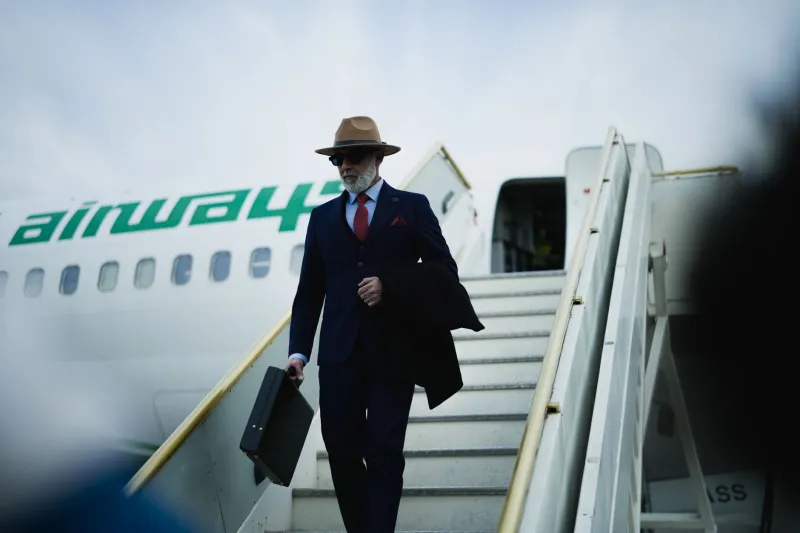
Off the Grid, On the Record: How Elite Executives Are Using Private Aviation to Meet Without Being Seen

Every commercial flight generates a document trail. The booking record. The TSA checkpoint timestamp. The gate scan. The credit card transaction. The geolocation data from the mobile device that connected to the airline's WiFi. The security camera footage from the terminal. The loyalty program activity. The hotel check-in at the destination. Taken together, these data points construct a precise account of who traveled where, when, and — through inference — with whom.
For executives managing competitive intelligence, sensitive negotiations, or strategic conversations that carry market-moving implications, this trail is not a bureaucratic footnote. It is a liability.
The Commercial Record as Intelligence Asset
The surveillance infrastructure surrounding commercial aviation in the United States is among the most comprehensive in the civilian world. The Transportation Security Administration maintains passenger records. Airlines retain booking and boarding data. Airport authorities operate extensive camera networks. Third-party data aggregators compile flight records that are legally available for purchase by competitors, journalists, activist investors, and regulatory agencies.
This infrastructure was designed for security purposes, and within that purpose it functions as intended. But it produces a secondary effect that the architects of commercial aviation surveillance did not prioritize: it makes the movements of business figures trackable with a precision that would have been unimaginable two decades ago.
A hedge fund manager who flies commercially to a city where a potential acquisition target is headquartered generates a discoverable record of that trip. A corporate board member who travels to meet with an activist investor creates a data point that, assembled with other data points, can reconstruct a strategic narrative. A family office principal who visits a jurisdiction known for particular regulatory structures leaves a trail that sophisticated counterparties know how to read.
The competitive intelligence industry has adapted to this reality with considerable sophistication. Firms specializing in alternative data routinely monitor commercial flight records as a signal of executive intent. The inference drawn from a CEO's unannounced trip to a competitor's home market is often more actionable than anything in a quarterly earnings call.
Private Aviation and the Absence of a Manifest
Private aviation operates under a fundamentally different disclosure architecture. Flights conducted under Part 91 of the Federal Aviation Regulations — the framework governing non-commercial private operations — do not require passenger manifest disclosure to any public database. The aircraft's tail number is visible to flight tracking services, but the identities of those aboard are not. An aircraft can be repositioned, routed indirectly, or operated from a secondary airport to further reduce the inferential value of tracking data.
This is not evasion. It is the exercise of privacy rights that are entirely consistent with federal aviation law. The same legal framework that governs a family's weekend flight to their vacation property governs a confidential advisory session between a CEO and a prospective merger counterparty. The distinction lies entirely in the strategic intentionality applied to the latter.
For executives who understand this architecture, private aviation offers something no commercial alternative can: the ability to convene a meeting that, from the perspective of the external surveillance environment, did not occur.
The Anatomy of a Confidential Airborne Session
The practical mechanics of using private aviation for sensitive strategic meetings are straightforward, though the strategic considerations are layered. A principal wishing to meet confidentially with an advisor, a board member, or a counterparty arranges for the aircraft to depart from a fixed base operator — typically a private terminal facility entirely separate from the commercial airport infrastructure. No commercial ticket is purchased. No loyalty program is credited. No TSA record is generated.
The meeting itself occurs in the cabin, which is physically inaccessible to anyone not invited aboard. There are no adjacent tables, no hotel corridors, no shared walls. The conversation is contained within an environment that the principal controls absolutely. Upon landing, the parties depart through a private terminal with similarly limited public exposure.
For particularly sensitive discussions, some principals choose to conduct airborne meetings that are essentially positioning flights — flights that depart and return to the same airport, or that route to a destination without a formal ground meeting, preserving the appearance of ordinary travel while enabling substantive in-air dialogue.
Legal and Ethical Boundaries
It is essential to examine this practice within its legal and ethical framework, because the absence of a surveillance record does not imply the absence of legal obligation. Private aviation enables confidential meetings; it does not enable illegal ones.
Executives who use private aviation for discussions involving material non-public information remain subject to securities law regardless of venue. The SEC's insider trading framework does not include a private jet exemption. Conversations that constitute anticompetitive coordination remain subject to antitrust law whether they occur at a boardroom table or at cruising altitude. The legal and ethical obligations governing a meeting do not change because the meeting is unmonitored.
What private aviation provides is protection from extralegal surveillance — the competitive intelligence gathering, the journalistic inference, the activist investor data analysis — that commercial travel enables. It does not provide, and responsible practitioners do not seek, protection from legitimate regulatory oversight.
The distinction matters. The most sophisticated users of private aviation for confidential meetings are not attempting to circumvent law. They are managing information asymmetry in a competitive environment where their commercial travel records constitute a form of involuntary disclosure that their counterparties exploit.
Strategic Discretion as a Competitive Moat
The value of conducting sensitive meetings without generating a commercial record is, at its core, a function of information asymmetry. In competitive markets, the party that knows more about the other's intentions and movements holds a structural advantage. Commercial aviation systematically erodes that advantage for those who use it. Private aviation preserves it.
This is why the executives who understand private aviation's strategic dimensions most clearly are often those operating in the most intensely competitive information environments: activist defense, M&A strategy, competitive intelligence, and early-stage capital formation. In each of these contexts, the ability to convene, deliberate, and separate without generating a discoverable record is not a luxury. It is a competitive instrument.
The private jet cabin, in this framing, is not merely a vehicle. It is the most defensible meeting room available to the American executive class — a space where strategy can be formed, tested, and refined in the one environment that the data economy has not yet fully colonized.